
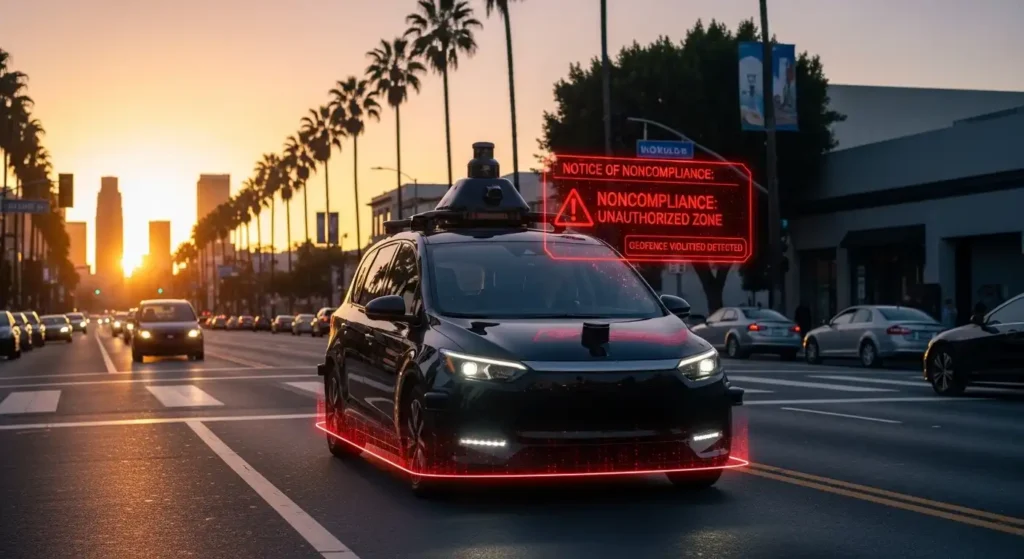
The “Accountability Gap” is Closed: Notices of Noncompliance
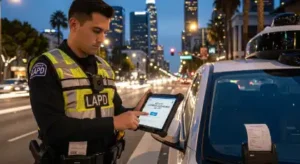 Before AB 1777, police officers faced a frustrating hurdle: they couldn’t issue a ticket to a car with no driver. Because California’s Vehicle Code was written for human operators, software infractions often went unpunished at the scene of an accident. AB 1777 solves this by introducing the “Notice of Autonomous Vehicle Noncompliance.”
Starting now, Los Angeles peace officers have the authority to issue these notices directly to the manufacturer of the autonomous vehicle for any traffic violation—be it an illegal U-turn, speeding, or failing to yield. For an injury victim, this notice is a “smoking gun.” It provides documented proof of a traffic violation by the AV, which can be used as negligence per se in a personal injury lawsuit to establish that the manufacturer is liable for your damages.
Manufacturer Obligations: New Safety Guardrails
AB 1777 doesn’t just address what happens *after* an accident; it mandates specific safety technologies that manufacturers must maintain to operate on California roads. Failure to comply with these requirements can also serve as a basis for liability.
1. The 24/7 Emergency Response Line
Manufacturers are now required to maintain a dedicated emergency telephone line. This isn’t just for customer service; it’s a direct link for first responders. In the event of a crash, LAFD or LAPD must be able to reach a remote human operator immediately to disable the vehicle or move it out of the way of emergency traffic.
2. Two-Way Voice Communication
Every AV must be equipped with two-way voice communication. This allows emergency responders—or even an accident victim—to communicate directly with the manufacturer’s remote support team from the vehicle itself. If a vehicle’s communication system fails during a crisis, it could be seen as a breach of the 2026 standard of care.
3. Mandatory Geofencing Compliance
One of the most innovative parts of AB 1777 is the Emergency Geofencing requirement. Emergency officials can now issue a digital “geofence” command to AV manufacturers during a fire, flood, or active crime scene. Once received, the manufacturer has exactly two minutes to direct its entire fleet to leave or avoid the identified area. If an AV enters a cordoned-off emergency zone and causes further injury, the manufacturer faces strict liability for ignoring the geofence.
Liability Breakdown: Negligence vs. Product Liability
When you are hit by a driverless car in Los Angeles, your legal claim will likely fall into two distinct categories. AB 1777 helps clarify which route your attorney will take.
| Claim Type | Basis for Liability | Evidence Under AB 1777 |
|---|---|---|
| Negligence | The vehicle failed to follow California traffic laws (Duty of Care). | Notice of Autonomous Vehicle Noncompliance issued at the scene. |
| Product Liability | The vehicle’s software or sensors were defectively designed. | 72-hour DMV reporting logs and internal telematics data. |
This hybrid approach is similar to the liability structures we see in other modernized California laws. For instance, in our analysis of California SB 721 balcony safety updates, we noted that strict inspection requirements create a paper trail that makes it much easier to prove a “breach of duty.” AB 1777 does the same for the software “brains” of the automotive world.
The 72-Hour Reporting Rule
Transparency is the enemy of corporate evasion. AB 1777 requires manufacturers to provide the DMV with a copy of any notice of noncompliance within 72 hours of its issuance. For a Los Angeles accident lawyer, this means that the evidence of a vehicle’s prior “bad behavior” is now part of a public regulatory record, rather than being buried in a proprietary company database.
Furthermore, this aligns with the broader 2026 MICRA medical malpractice reforms, which emphasize transparency and fair compensation. As California continues to raise the bar for corporate and professional accountability, the “black box” of autonomous driving is finally being opened to the public.
What To Do If You Are Hit by a Driverless Car in LA
- Demand a Notice of Noncompliance: If the police arrive, ensure they issue the formal notice to the manufacturer as provided by AB 1777.
- Record the ID: Every AV has a unique fleet number or license plate. Take a photo of it immediately.
- Identify the Sensors: If possible, take photos of the cameras and LiDAR sensors. Obstructed or dirty sensors are a common cause of “vision failure” in AV accidents.
- Consult an Expert: AV cases involve massive tech corporations with deep pockets. You need an attorney who understands the intersection of the California Vehicle Code and AI technology.
Conclusion
California’s AB 1777 marks the end of the “Wild West” era for autonomous vehicles in Los Angeles. By treating these sophisticated machines as responsible entities and holding their manufacturers to strict communication and reporting standards, the law finally puts the safety of LA residents first. While technology will continue to evolve, the right to a safe road remains constant.