
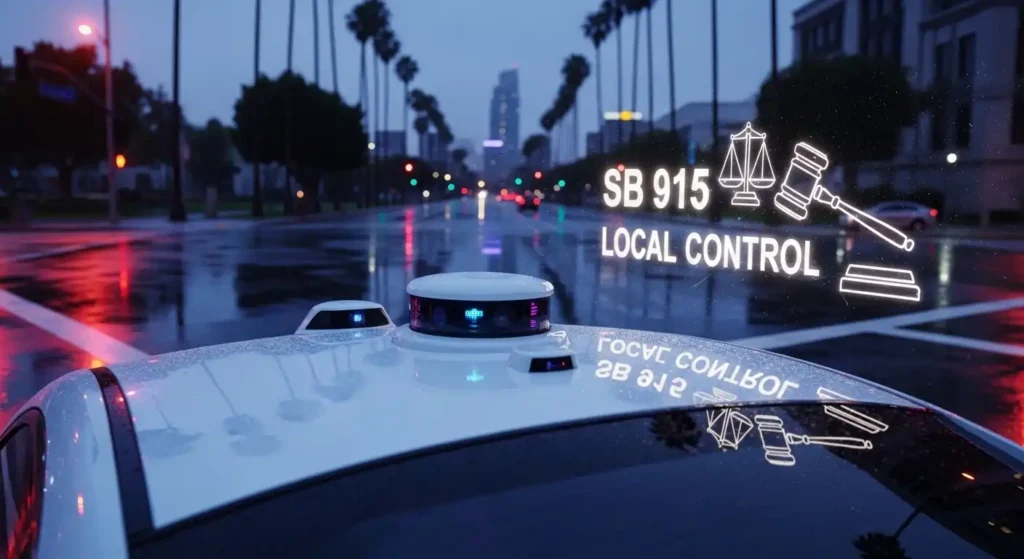
In early 2026, the streets of Los Angeles reached a tipping point. What began as a tech experiment has evolved into a daily reality: hundreds of driverless taxis now navigate the congested corridors of Hollywood, Santa Monica, and Downtown LA. But as the number of autonomous vehicles (AVs) grows, so does the complexity of the legal landscape. The implementation of Senate Bill 915 (SB 915) has fundamentally shifted how we define liability. If you are involved in a collision with a robotaxi today, the old rules of the road may no longer apply.
The SB 915 Shift: From State Oversight to Local Control
For years, companies like Waymo and Cruise operated under a regulatory umbrella provided by the California DMV and the Public Utilities Commission (CPUC). Local authorities in Los Angeles often found their hands tied when safety issues arose. SB 915 changed that dynamic by granting “Local Control” to cities and counties. In 2026, Los Angeles now has the power to set its own ordinances regarding AV permits, fleet density, and safety protocols.
From a legal perspective, this means a Los Angeles autonomous vehicle accident lawyer must now investigate whether an AV was in violation of specific city-level safety ordinances at the time of a crash. Was the vehicle operating in a restricted zone? Did it exceed the local fleet cap? These “local” violations can be the smoking gun in a personal injury lawsuit, providing the necessary evidence of negligence that state-wide regulations might have missed.
The Three-Tiered Liability Framework in 2026
In a traditional car accident, liability is usually a straightforward debate over which human driver made a mistake. In the era of driverless taxis, liability is rarely singular. We now look at three distinct tiers of responsibility:
- Product Liability (The Tech Tier): If the accident was caused by a “ghost braking” event or a sensor failure in LA’s coastal fog, the manufacturer of the hardware or the software developer may be held strictly liable for a defective product.
- Operational Negligence (The Fleet Tier): Under SB 915, fleet operators must maintain rigorous safety standards. If a company fails to install a critical software patch or ignores a known sensor calibration issue, they are liable for operational negligence.
- Vicarious Liability (The Owner Tier): Even if there is no human driver, the entity owning the vehicle is often held responsible for the damages caused by that vehicle’s “actions” on public roads, much like a trucking company is responsible for its fleet.
Common 2026 AV Accident Scenarios in Los Angeles
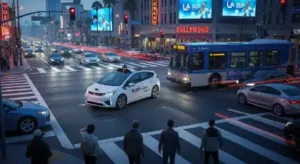 As we monitor data from the first quarter of 2026, several recurring accident profiles have emerged. One of the most common is the “Unprotected Left Turn” error at busy intersections. Despite advancements in AI, navigating cross-traffic on Sunset Boulevard remains a challenge for silicon-based drivers. Another rising trend is the “Emergency Vehicle Obstruction,” where AVs fail to yield to LAPD or LAFD sirens, leading to secondary collisions.
For victims, these scenarios present unique challenges. Unlike a human driver who might admit fault at the scene, an AV is a “black box” of data. Securing that data—logs that show what the car “saw” and “decided” in the milliseconds before impact—is the most critical step in a modern injury claim.
Why You Need an Attorney Who Understands “Algorithm Negligence”
Tech companies have deep pockets and even deeper legal teams. They often argue that their vehicles are “mathematically safer” than humans to deflect from individual incidents. However, “safer on average” is not a legal defense when their specific vehicle causes your specific injury. We utilize accident reconstruction experts who specialize in digital forensics to peel back the layers of AI decision-making.
Under California’s comparative negligence laws, these companies may try to shift blame onto you—the pedestrian or the other driver. They might claim you were “unpredictable” or that you “confused” the sensors. Our job is to hold the technology to the highest standard of the law, ensuring that innovation never comes at the cost of human safety.
Conclusion: Protecting the Residents of Los Angeles
SB 915 has given Los Angeles a voice in the autonomous revolution, but the legal battle for victims is just beginning. As the city continues to refine its ordinances, the definition of “reasonable care” for a robotaxi will continue to evolve. If you have been injured, you are not just a statistic in a tech company’s beta test—you are a victim with rights.