
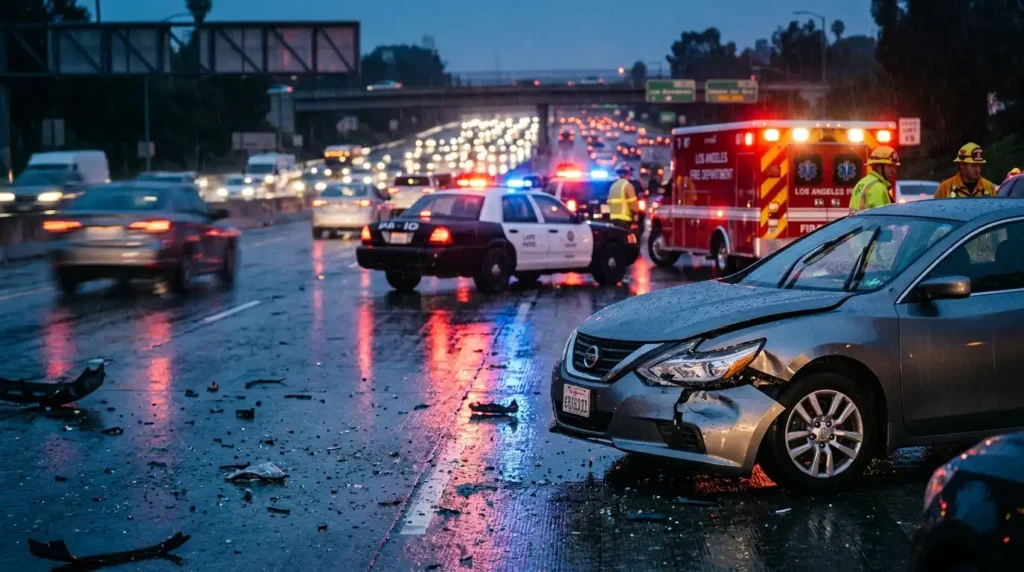
For decades, California motorists drove under auto insurance requirements established back in 1967. Under Senate Bill 1107, California enacted a long-overdue update to its minimum financial responsibility limits. While raising legal minimums aims to protect crash victims, it simultaneously creates new legal and financial challenges for injured drivers. Understanding how SB 1107 impacts your rights reveals why Uninsured and Underinsured Motorist (UM/UIM) coverage is now an absolute necessity on Los Angeles roads.
1. The SB 1107 Overhaul: Breaking Down the New Minimum Limits

Prior to the passage of Senate Bill 1107, California maintained outdated minimum auto insurance liability requirements of $15,000 for injury or death to one person, $30,000 for total injuries per accident, and $5,000 for property damage (commonly known as 15/30/5 limits). In a modern economic landscape dominated by rising healthcare costs and higher vehicle repair expenses, those legacy limits frequently left accident victims facing severe financial shortfalls.
To address this shortfall, SB 1107 increased mandatory liability minimums across the state to 30/60/15:
- $30,000 for Bodily Injury or Death: The maximum amount an at-fault driver’s policy will pay to a single injured individual.
- $60,000 Total Bodily Injury per Accident: The absolute limit available to split among all injured victims in a single collision, regardless of how many people are hurt.
- $15,000 Property Damage: The maximum payout provided to repair or replace damaged vehicles and public/private property.
While doubling bodily injury limits appears to double consumer protection on paper, real-world injury claims tell a far more complicated story—especially in fast-paced metropolitan corridors like Los Angeles.
2. Why $30,000 Still Falls Short in Serious Los Angeles Accidents
While a $30,000 per-person minimum is a clear step forward from $15,000, modern medical treatment costs quickly eclipse these updated figures. A severe traffic collision on the I-5, 405, or 101 freeway often results in catastrophic injuries requiring immediate emergency care.
Consider the standard medical expenses associated with a moderate-to-severe car accident in Southern California:
- Ambulance Transportation & Emergency Room Triage: $3,000 to $8,000
- CT Scans, MRIs, and Diagnostic Imaging: $4,000 to $10,000
- Surgical Intervention or ICU Stay: $25,000 to $100,000+
- Physical Therapy & Ongoing Rehabilitation: $5,000 to $15,000
When you factor in lost wages during recovery, pain and suffering, and future medical treatment, a victim’s total damages can easily exceed $100,000. If the at-fault driver carries only the state-mandated $30,000 minimum liability policy, that driver is considered underinsured relative to your total losses.
3. The Growing Threat of Uninsured and Underinsured Drivers
An unintended side effect of higher insurance requirements is increased policy premiums. As auto insurers adjust premiums upwards to compensate for higher mandatory minimum payouts, a growing percentage of drivers choose to lapse their policies or drop coverage entirely.
California routinely ranks among the states with high numbers of uninsured motorists. When an uninsured driver causes a crash, or an underinsured driver with a 30/60/15 policy causes catastrophic harm, the injured victim cannot look to the at-fault driver’s insurance company for full compensation. Trying to collect personally against an underinsured driver often yields little to no recovery, as individuals carrying minimal coverage rarely possess significant personal assets.
4. How UM/UIM Coverage Serves as Your Personal Financial Shield
Uninsured Motorist (UM) and Underinsured Motorist (UIM) coverages are designed specifically to protect you and your passengers when the driver who hit you lacks sufficient insurance.
- Uninsured Motorist (UM) Coverage: Steps into the shoes of the at-fault party if they have no auto insurance at all or commit a hit-and-run. Your own insurance provider pays your medical bills, lost earnings, and pain and suffering up to your selected UM limit.
- Underinsured Motorist (UIM) Coverage: Triggers when the at-fault driver has insurance, but their policy limits are lower than your total losses and lower than your own UIM limits. Your UIM policy covers the remaining gap between their minimum limits and your actual damages.
Under California Insurance Code § 11580.2, insurance companies must offer UM/UIM coverage on every auto policy sold in the state. While drivers have the legal right to decline it in writing, doing so leaves them dangerously exposed. To fully safeguard your family, carrying UM/UIM coverage matching your primary bodily injury limits (e.g., 100/300 or 250/500) is one of the most cost-effective decisions you can make.
5. Navigating UM/UIM Claims with an Experienced Los Angeles Personal Injury Lawyer

Filing a UIM claim involves severe legal nuances. Because you are seeking compensation from your own insurance carrier under UIM provisions, your insurance company effectively assumes an adversarial role to minimize their payout. They may dispute the severity of your injuries, argue pre-existing conditions, or assert that the at-fault driver was not entirely to blame.
Navigating California’s updated SB 1107 statutory framework requires precise coordination between third-party liability claims and first-party UIM arbitration. An experienced Los Angeles personal injury attorney ensures that policy limits are properly stacked, third-party settlements are exhausted without waiving UIM rights, and crash victims receive the full financial compensation they deserve.