
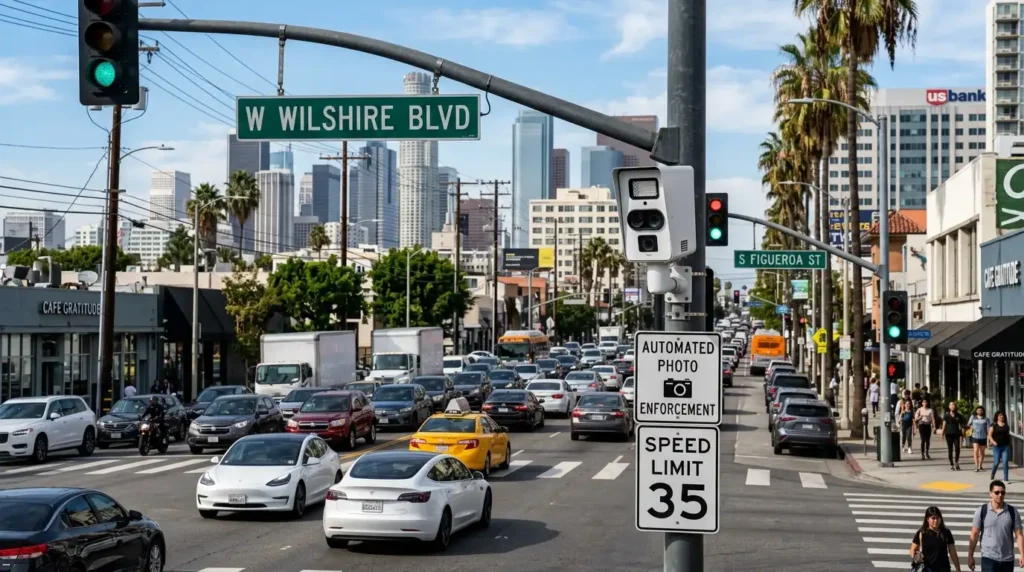
The Los Angeles Department of Transportation (LADOT) is deploying its automated Speed Safety Systems Program across designated high-injury corridors under California Assembly Bill 645 (AB 645). Authorizing up to 125 camera systems across key municipal districts, this five-year pilot program aims to curb reckless speeding and reduce severe traffic injuries. However, while the primary objective of AB 645 is public safety, the installation of these sophisticated tracking systems marks a significant shift in how personal injury attorneys investigate, prove, and litigate car accident liability claims throughout Southern California.
Understanding AB 645: How Los Angeles Speed Safety Cameras Work
 Passed by the California State Legislature, AB 645 permits six California jurisdictions—including the City of Los Angeles—to install automated speed enforcement technology in specific high-risk zones, such as school corridors, active street segments with high collision histories, and senior community areas. The systems utilize optical sensors and radar technology to photograph the rear license plates of vehicles traveling 11 miles per hour or more above the posted speed limit.
It is crucial to understand the administrative nature of these violations. Under California Vehicle Code rules established by AB 645, automated speed citations are categorized as civil infractions issued to the registered owner of the vehicle. They carry financial penalties starting at $50—increasing based on recorded velocity—but do not assign criminal points to a driver’s DMV record or trigger direct auto insurance rate hikes. However, when an excessive speed violation results in a severe motor vehicle collision, the underlying electronic data collected by these systems shifts from a routine civil ticket into vital legal evidence.
Establishing Negligence Per Se with Speed Camera Data
In a standard personal injury or wrongful death lawsuit resulting from an auto crash, the injured party (plaintiff) carries the legal burden of establishing that the at-fault driver was negligent. Under California’s doctrine of negligence per se (California Evidence Code Section 669), negligence is automatically presumed if the defendant violated a statute or ordinance, the violation proximately caused death or injury, and the statute was designed to prevent that specific type of harm.
Before AB 645, proving an opponent’s speed required relying on eyewitness testimony, post-crash vehicle telemetry data, or costly accident reconstruction experts evaluating skid marks and crush damage. Automated speed camera data provides objective evidence. Pursuant to California Vehicle Code provisions governing AB 645, official violation notices and system records are admissible in court as prima facie evidence of the facts stated within them. If a speed safety camera captures a negligent driver moving 25 mph over the limit moments before slamming into another vehicle, that time-stamped speed record establishes a strong foundation for negligence per se.
| Evidence Category | Traditional Crash Investigations | AB 645 Speed Camera Integration |
|---|---|---|
| Speed Verification | Expert reconstruction & skid mark estimates | Calibrated digital radar/laser speed logs |
| Proof of Location & Time | Police report estimates & driver memory | Time-stamped image data & geo-coordinates |
| Liability Presumption | Contested driver statements | Prima facie statutory violation evidence |
Comparative Fault and Insurance Defense Tactics
California operates under a pure comparative negligence system (California Civil Code Section 1431.2). This means an injured party can recover financial compensation even if they were partially at fault for an accident, though their overall financial recovery is reduced by their allocated percentage of fault.
With 125 automated enforcement cameras monitoring major traffic arteries throughout Los Angeles, insurance defense adjusters will actively seek access to speed camera logs. If an injury victim was traveling 12 mph over the limit when a left-turning driver cut across their lane, the defense may use the automated speed data to argue shared fault. Defense attorneys will claim that had the plaintiff been traveling at the posted limit, the collision could have been avoided or its severity significantly reduced. Consequently, speed camera data acts as a double-edged sword that experienced personal injury lawyers must carefully navigate.
Subpoenaing Speed Camera Records and Data Retention Limits
While AB 645 speed safety cameras generate valuable objective data, securing this evidence for a personal injury claim requires swift action. State legislation includes strict civil liberties and privacy safeguards regulating how LADOT manages stored footage:
- Facial Recognition Prohibition: System cameras are restricted to photographing only the rear license plate and rear profile of the vehicle; facial recognition technology is explicitly forbidden.
- Strict Destruction Timelines: Under AB 645, license plate data that does not capture a speeding violation must be erased within 5 days. Data captured during a violation must generally be deleted within 60 days following final resolution of the administrative notice, unless preserved under legal hold.
- Court Subpoena Requirements: LADOT is legally prohibited from releasing raw photographic or speed monitoring records to outside civil litigants without a formal court order or valid civil subpoena.
Because of these narrow data destruction windows, accident victims cannot assume that speed camera records will remain archived indefinitely. Engaging a Los Angeles car accident attorney immediately after a serious crash ensures that spoliation letters and emergency subpoenas are issued to preserve key electronic files before automatic deletion protocols clear the system servers.
How a Los Angeles Car Accident Lawyer Protects Your Rights
 Navigating an auto collision claim in the era of automated traffic enforcement requires an understanding of both local municipal regulations and complex tort law. The legal team at los-angeles-accident-lawyer.com assists accident victims by:
- Filing immediate evidence preservation requests to secure time-sensitive LADOT camera telemetry and location logs.
- Leveraging prima facie speed evidence to hold reckless, speeding drivers accountable under California negligence standards.
- Rebutting aggressive insurance company tactics that attempt to assign unfair comparative fault to injured victims.
- Working directly with crash reconstruction specialists and medical experts to build bulletproof claims for maximum financial recovery.
If you or a family member has been injured in a crash along a Los Angeles street, do not leave your financial recovery to chance. Contact our experienced personal injury team today for a free, no-obligation case evaluation to learn how we can protect your rights under California’s evolving traffic laws.