

The landscape of personal injury litigation in Southern California has just experienced its most volatile, high-stakes shift in recent history. On June 25, 2026, Governor Gavin Newsom officially signed Senate Bill (SB) 623—formally titled the Fair Medical Billing & Rideshare Safety Act. This landmark statute is the direct product of a dramatic, multi-million dollar legislative compromise brokered between tech giant Uber Technologies and the Consumer Attorneys of California (CAOC). By codifying this agreement, both factions successfully withdrew competing, aggressively funded initiatives from the upcoming November 2026 ballot, averting a bruising $150 million political war.
The Threat That Was Avoided: No Caps on Legal Representation
 To grasp why SB 623 is being hailed as an essential, stabilizing compromise, one must first look at the devastating ballot initiative it effectively killed. Uber’s originally proposed constitutional amendment (Initiative #25-0022) sought to implement an absolute 25% cap on attorney contingency fees for nearly all motor vehicle accident cases across California—even those completely unrelated to rideshare applications. Crucially, that proposed framework mandated that all out-of-pocket litigation expenses (such as expert witness fees, medical depositions, and accident reconstructions) had to be absorbed inside that 25% envelope.
In complex car accident lawsuits in Los Angeles, where proving liability against commercial entities or municipal road hazards can require upwards of $100,000 in advanced costs, that restrictive math would have bankrupted traditional contingency-fee practices. The real victims would not have been the law firms, but the severely injured individuals who would no longer be able to find a qualified, high-caliber personal injury lawyer willing to take on the massive financial risk of building a case against corporate insurance defense teams. By negotiating the passage of SB 623, the CAOC successfully protected access to justice, leaving standard contingency-fee structures intact for California drivers.
The Core Shift: New Limits on Medical Lien Recoveries
While consumer attorneys successfully defended their fee structures, Uber secured massive, targeted tort reform regarding how medical damages are calculated in rideshare-specific civil actions. The absolute heart of SB 623 introduces strict parameters surrounding medical liens. In personal injury law, a medical lien allows an uninsured or underinsured crash victim to receive immediate, life-saving medical care from a doctor or surgeon who agrees to defer payment until the conclusion of the lawsuit. Historically, these billed lien amounts could be significantly higher than standard health insurance reimbursement rates.
Under the new statutory framework of SB 623, the maximum recoverable medical-expense damages for treatment provided by a lien-based healthcare provider are strictly capped:
- The 70th Percentile FAIR Health Cap: Recoverable medical damages are now explicitly tied to the objective, nationally trusted FAIR Health database. Recovery cannot exceed the 70th percentile of billed charges for that specific medical procedure within the geographic area where the treatment occurred.
- The Lien-Sale Limitation: If a medical provider chooses to sell or factor their outstanding medical account receivable to a third-party financial institution, the maximum recoverable amount in court is strictly limited to the actual dollar amount the financier paid to acquire that lien. This immediately cuts out the ability of financial entities to collect inflated, artificial windfalls at the expense of the claim value.
- Itemized Transparency: The bill mandates that all lien-based medical networks utilize standardized, uniform CPT (Current Procedural Terminology) and HCPCS billing codes, bringing unprecedented accountability to personal injury medical documentation.
Importantly, these restrictive medical lien caps apply exclusively to civil actions arising from automobile accidents involving a network company or an app-based driver—they do not apply universally to standard rear-end collisions between two private motorists in Los Angeles.
Crackdown on Self-Dealing and Referral Ethics
The legislative compromise also brought sharp regulatory sunlight into the close-knit relationships between personal injury attorneys and medical networks. SB 623 introduces explicit ethics-style restrictions designed to eliminate conflicts of interest. Moving forward, it is strictly unlawful for a contingency-fee attorney representing a plaintiff in a covered rideshare accident lawsuit to receive any form of financial kickback, fee-split, or bonus for directing a client to a specific lien-based medical provider.
Furthermore, the law prohibits attorneys from referring clients to medical facilities in which the lawyer or their immediate family members hold a direct ownership stake or financial interest. Additionally, all lien transfers, financing arrangements, and medical factoring sales must be fully disclosed to opposing counsel within 30 days of the transaction. This transparency allows claims adjusters and defense counsel to inspect whether medical decisions were driven by actual clinical necessity or alternative financial relationships.
Enhanced Rideshare Safety Measures and Direct Negligence
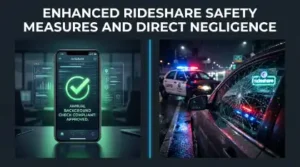 To balance the medical lien concessions granted to the tech platforms, the CAOC and consumer advocates secured major safety enhancements aimed at protecting rideshare passengers throughout Los Angeles. SB 623 dramatically stiffens the driver screening requirements for companies like Uber and Lyft. Platforms are now statutorily required to complete comprehensive, national criminal background checks on all drivers *before* their account can be activated on the app, with mandatory re-screening occurring at least once per year thereafter.
The law also drastically expands the categories of criminal convictions—such as domestic violence, stalking, human trafficking, and repeat DUIs—that automatically disqualify an individual from operating a rideshare vehicle. For Los Angeles accident lawyers, this provision provides a powerful new litigation weapon. If an inadequately vetted rideshare driver assaults a passenger or causes a devastating crash due to an unflagged history of reckless driving, the platform’s failure to document strict compliance with these annual background check mandates serves as direct statutory evidence of corporate negligence.
Navigating the New Timeline for LA Accident Claims
If you or a loved one are involved in a collision involving an Uber, Lyft, or app-based delivery vehicle in Los Angeles, understanding the timing of your claim is paramount. The safety mandates and background check provisions take effect quickly, while the new medical lien damages calculation rules officially apply to accidents occurring on or after January 1, 2027.
Because these case dynamics are changing rapidly—coupled with the fact that California recently reduced the required uninsured/underinsured motorist (UM/UIM) coverage that rideshare companies must carry from $1 million to a much lower tier ($60,000 per person/$300,000 per incident)—securing legal counsel early is more critical than ever. Navigating the overlapping layers of commercial insurance policies, documenting strict compliance logs, and accurately calculating FAIR Health database caps requires an experienced, forward-thinking legal team that understands exactly how to protect your financial recovery under SB 623.